4 December 2014

Open Skies

It is not only the planes themselves that have an impact on the environment. The ways in which they are regulated also needs to be taken into consideration as this can determine where aircraft can fly, how often, and if they meet a set of standards. I am going to look at the environmental impacts of the EU-US Open Skies Agreement, which was written about by Mayor and Tol (2009). In addressing the environmental concerns, I also hope to make apparent the complexities in co-ordinating global air travel. 

The EU-US Open Skies Agreement was launched in 2007 and came into effect the following year. It had the aim of making aviation a more levelled playing field between Europe and the USA, two of the largest global aviation markets. It was to remove  bilateral agreements in place between the USA and countries of Europe, and replace it with a single aviation agreement. It was hailed from and economic and financial point of view - but its environmental impacts have not been extensively examined - which is where the article  (Mayor and Tol 2009) comes in handy!

The agreement allows European and American carriers to fly to any city in the opposite continent, from any city in their own. This liberalisation allows for greater competition to and from both small airports and larger hubs. Before this for example British Airways and Virgin Atlantic were the only two British carriers entitled to fly from London Heathrow to JFK in New York (Heathrow's most flown route). Such an agreement would undoubtedly result in increased passenger flows and traffic. More details of the agreement can be found in this Guardian article.

The paper hints at greater carbon dioxide emissions that will make climate policy objectives increasingly difficult to achieve, especially considering that only until recently was aviation included into European emission reduction policies. A model to predict future scenarios resulting from increased tourist travel and lower plane fares as a result of the agreement was used. It found that the global emissions will increase will be smaller than the increase in transatlantic travel, due to a reduction in travel to other places, as a result of more transatlantic flights.

Do not unfasten your seat belt to go and book your dream holiday to America just yet though! A single person on a round trip transatlantic flight from New York to Europe will produce 1 to 2 tonnes of carbon dioxide, according to this article from the New York Times. It  discusses aviation emission reduction policies - where it describes the EU emissions trading scheme prohibition act of 2011 as a "somewhat lonely attempt to rein in planet-warming emissions." It is safe to say they weren't on board!


Open Skies:
Mon - Fri 7am - 10pm
Sat 7am - 11pm
Sun 9am - 6pm

1 December 2014

I See A Ship Out The Window

Over the posts so far, I have been exploring how aircraft effect the environment in terms of the emissions they release when they fly. I aim to put this into context and compare it with other modes of transport - after all as I mentioned in my very first post (and is talked about in the video in the second post), although planes appear to be absolutely detrimental to the environment from the media attention they receive, they only account for around 2% of annual global CO2 emissions.

Fugletvedt et al. (2008) wrote about how although contributing significantly to global emissions, the contribution of different modes of transport has not been quantified. They  predict that whereas today (or in 2008!) transport in general accounted for 20-25% of total annual CO2 emissions, by 2050 this is estimated to rise to 30-50%. 

The paper describes four main mechanisms through which all transport related emissions can effect the climate. These are:

1. The direct emission of greenhouse gases, notably CO2.

2.  The emission of indirect greenhouse gases, for example gases like nitrogen oxides, and carbon monoxide that affect the oxidising capacity of the atmosphere.

3. The direct emission of aerosols or aerosol precursors such as black and organic carbon and sulphur compounds. 

4. The indirect emission of aerosols that trigger alterations in the distribution and properties of clouds. 

Note that many of these effects has already been discussed in relation to aviation in previous posts. 

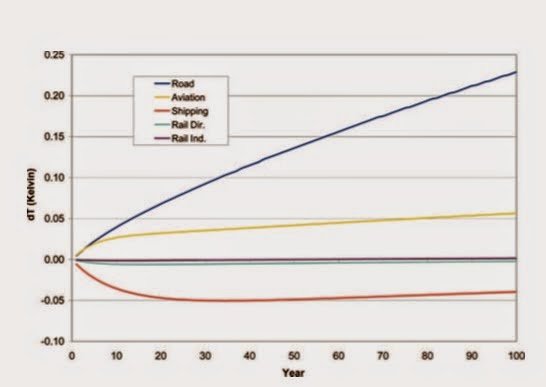
Attributing these effects to certain modes of transport is difficult because multiple chemical and physical mechanisms can occur when these emissions are released. The paper highlights further difficulty in calculating the climatic costs of transport due to the differing time scales involved. The effects of  transport emissions on ozone, sulphates and black carbon may last months and days, where as more well mixed greenhouse gases (methane, CO2, and NOx) have an adjustment period of decades and centuries. Based on these timescales, it is estimated that current emissions from transport will be responsible for 16% of the integrated net forcing over the next 100 years for all man made emissions. The paper  places road transport as being responsible for the most warming and shipping for producing the greatest cooling effect. 

Complementing the above mentioned paper is Berntsen and Fuglestvedt (2008). They have expanded on how depending on time scale, different modes of transport, have differing effects on the climate (not surprising seeing as the same author worked on the aforementioned paper). They reiterate that different effects and emissions from transport can result in either a warming or cooling effect. Looking at the year 2000, road transport is seen to have the largest effect on global mean temperature. Road travel comes before aviation, which despite having strong but short-lived effects, they can resonate up to a decade after emission. In contrast shipping results in a cooling effect  (through the release of sulphur dioxide and NOx) which can last up to 4 years after emission but on a longer timescale, shipping too leads to a warming effect. 

More work on the matter was done a couple years later by Borken-Kleefeld et al. (2010)  - also featuring Fuglestvedt as a co-author (I would have been more surprised not to have seen his name!). Anyway, they again emphasise looking at the timescales of modes of transport in relation to the type of radiative forcing caused. They mention that air travel results in a lower temperature change per passenger-kilometre than the car... in the long run. And that per passenger-hour travelled, aviation's impact is higher than for cars, which doesn't really come as a surprise!

By looking into the effects of different modes of transport, it has become apparent that there is no one way at looking and comparing them. There are many variables to consider: the time scales involved with the emissions, frequency of use, size of the emissions released, passenger-kilometre, passenger-hour.. maybe if you stop for food a the service station? I agree with Berntsen and Fuglestvedt (2008) in the difficulty of accounting for different modes of transport on creating policy for the improvement and reductions of this sector... when for example would you set a time scale when at first the effects of shipping emissions are cooling but then revert to warming? And that air travel is worse on a short scale but road travel is worse overall in the long run. 


Future temperature change (in K) from different modes of transport based on constant emissions for the year 2000. Taken from Berntsen and Fuglestvedt (2008)

26 November 2014

Oxygen Masks Will Drop From Above

Following on from the ways in which nitrogen oxides, released from aircraft alter the chemistry of the atmosphere, as was discussed in the previous post, I am going to focus on a paper I found (Barrett et al. 2010), that discuses the human health implications of these and other aviation related emissions. 
Passengers in planes aren't the only people who need oxygen masks!

The study finds that there are around 8000 annual premature mortalities attributable to emissions released by aviation, and which alter air quality. Such emissions can effect widespread areas of the world despite originating in isolated regions and corridors. A lot of this is due to global atmospheric circulation - which conveniently helps to funnel down the harmful and polluting chemicals into the lower troposphere so we can all benefit from them too.

The figure below taken from the paper describes how aircraft emissions in the upper troposphere in the Northern Hemisphere interact with existing circulation patterns. Peak aircraft emissions occur in the Ferrel atmospheric circulation cell. Air mixed with pollutants released from aircraft in this cell experiences subsidence at 30ºN latitude - as is shown by the brownish line in the Figure. 

(Barrett et al. 2010)
The truly global nature of the way aircraft emissions are spread around the world are explored in the paper. Impacts specifically to humans are linked by pointing aircraft attributable aerosols as responsible for around 3500 premature deaths in India and China despite their relatively low contribution to aircraft emissions. Their geographic location (at around 30ºN latitude) in relation to this atmospheric circulation is believed to be a large determining factor of this.  India for example experiences 7 times more deaths in relation to its aircraft emissions compared to the United States which experiences 7 times fewer deaths. It must be noted however that the number of premature deaths generated for India and China also takes into consideration background ammonia and the high population density in this region.

The paper quotes some quite alarming numbers of premature mortality aircraft cause, which admittedly isn't my top go to cloud gazing topic to think about when I do get the chance to fly (and a window seat), the paper does not really go beyond quoting numbers, and I imagine it is difficult to pin point premature mortality on aircraft emissions, given that their effects probably get manifested in various medical conditions? There is not much to compare such a study too either. Despite this, the study confirms that it is not only take off and landing emissions, close to ground level that are able to have an impact, and that emissions emitted at cruising altitudes are also able to exacerbate the balance of toxic chemicals lower down in the atmosphere. 


In case you haven't had the pleasure of studying Weather and Climate  - the following diagram simplifies global atmospheric circulation, the Ferrel cell that was referred to earlier is marked on. (Taken from the Met Office).

20 November 2014

Don't Get On The Wrong Side of An Oxide

Despite contrails being the most visible indication of the impact aircraft are having on the environment, they are certainly not the only form of pollution. In my first post, I touched upon the impacts of CO2 being released however, they are not the only emissions of environmental significance. The potent nitrogen oxides (NOx) and sulphur oxides (SOx) are also released, albeit in smaller quantities as CO2 but with potentially more damaging consequences. I must mention that these pollutants contribute to the formation of contrails and the modification of natural cirrus clouds too, for the sake of being able to mention contrails again!

Today, I am going to be looking at the well documented effects of nitrogen oxides. NOx emitted from aircraft today are 5 times more efficient at affecting the global ozone burden than emissions originating from ground transportation such as road vehicles (Hauglustaine and Koffi 2012). In spite of its higher potency as pollutant than CO2, the radiative forcing of NOx is relatively small as described in Fuglestvedt et al. (2009), Myhre et al. (2011), and Holmes et al. (2011). This is as a result of the opposing effects it has on ozone and methane in the atmosphere. 

NOx from aircraft promotes the formation of ozone (O3) in the troposphere and lower stratosphere. Ozone has a positive radiative forcing (i.e a warming effect). This enhancement of ozone is offset by the chemical alterations NOx has on the oxidising capacity of the atmosphere. NOx cause an enhancement of the oxidising capacity, which reduces the lifetime of atmospheric methane (CH4). This reduction in  methane leads to a negative forcing (i.e a cooling effect). Less methane also means less ozone is produced. This renders nitrogen oxides a forcing agent that is able to affect the chemistry of the atmosphere. 

Although the effects of NOx released by aircraft may not seem that bad, Köhler et al. (2008) investigated the disturbances to methane and ozone in the atmosphere as a result of nitrogen oxide input from aircraft. They concluded impacts varied depending on the altitude of the aircraft for example, a plane flying at 11 km would lead to an ozone increase of 200% and a reduction in methane lifetime per emitted mass of  NOx, 40% as strong as a plane flying 5 km altitude. 


The study also found that much like how the effect of ground based NOx emissions affect atmospheric ozone and methane differently depending on their geographic location, the same applies to aviation. The geographic distribution of NOx emissions has consequences for flight route planning, and it is predicted that growing aviation in Asia could lead to significant impacts regarding methane and ozone within the troposphere, even if emissions were to remain constant. 


This raises important questions as to what impact future increases in air travel will have as new flight routes open and increase in frequency, especially considering the planning currently involved in reducing the effects of emissions on the atmosphere. Also how strategies accounting for these harmful types of pollution will continue to be managed. 

How to plan for more planes?

8 November 2014

Chemtrails

During my search for information on contrails for the previous two posts, one word kept on coming up which didn't seem to want to go away: chemtrails. 

It is not very scientific of me to be doing a post on them, as you will see! but it was so persistent a word (try searching chemtrails for yourself!), that I thought I would do some digging...

Chemtrails are part of a conspiracy theory. It is the belief that governments are using  aircraft to spray chemical or biological agents for numerous top secret reasons. It is thought they are unlike contrails because they are longer lasting. Just in case all sorts of questions are racing through your mind at this point, rest assured that we in the UK are safe. Earlier this year, UK government via the Department of Energy and Climate Change stated that the "UK population is not being sprayed" after a freedom for information request. 


We all need an education  
Surprisingly, I could not find many scientific articles or journals on the matter. I managed to find an article in Australian Science, in an article entitled 'Chemtrails - Conspiracy theory?'. In it the contents of an hour long video entitled 'What in the World are they Spraying?' made by political activist Michael Murphy are addressed - especially the release of aluminium and its consequential health effects.

It is unlikely we will find evidence for the nanobots being deployed into the atmosphere via aircraft to modify the weather as the link below the picture above describes. Saying that, I found news articles from the BBC and Guardian reporting on how previously classified documents have suggested that experimental cloud seeding conducted by the RAF that was occurring at the beginning of the 1950s were partly responsible of the 1952 floods at Lynmouth, in which 35 people were killed. It remains an allegation that has not been proved. Early scientific studies such as Cooper and Jolly, 1970 have suggested that the sustained use of silver iodide in cloud seeding could have detrimental effects on some ecosystems, and that there was a responsibility to monitor the environmental impacts of such technology. 

I'll let your thoughts simmer whilst you watch this video... 


28 October 2014

Contrail Effects

A radiative forcing is something that disturbs the balance between incoming and outgoing radiation in the atmosphere. A positive forcing warms the surface, and a negative one cools it. Contrails, and the clouds which result from them (see the BBC link, mentioned in the previous post) are the largest radiative forcing associated with aviation. Despite their similar appearances, especially when longer lasting contrails begin spread out and resemble clouds, the radiative forcing for contrails is 9 times larger then for similar shaped, naturally formed cirrus clouds (Burkhardt and Kärcher 2011).

Contrails can be expected to have the same effects as cirrus clouds i.e to reflect incoming short wave radiation and to retain long wave outgoing radiation from the surface - this is due to the small ice crystals that contrails are made up of. Small differences in the properties between contrails and cirrus clouds for example the size of ice crystals however, creates some ambiguity and differences in the forcing effects of contrails. Contrails have a smaller vertical depth and are formed at cooler temperatures meaning that contrail induced cirrus clouds can form and persist high in the troposphere even when there are no natural cirrus clouds.

Ascertaining the global coverage of contrails is difficult as only young contrails, which still exhibit the classic line formation (see background picture to this blog) can be distinguished from natural cirrus cloud. It is impossible to tell from satellite imagery whether cirrus clouds have been induced by aircraft or are natural. It is also thought that global atmospheric circulation maintains a higher level of cirrus cloud over Europe in comparison to the USA, where there is more air traffic (Burkhardt and Kärcher 2011).

The aftermath of 9/11 presented a unique research opportunity in that there were no commercial flights in the 3 days that followed. Travis et al. (2002) compare the diurnal temperature range for the 11th - 14th September 2001 with that from 1971- 2000. They found there was an anomalous increase in diurnal temperature (1.1°C), which they partially attribute to the lack of contrails in this 3 day period. It has also been suggested that the presence of contrails, which ties up water vapour in the atmosphere, means that this vapour can not be used to expand natural cirrus clouds - and so can prevent their expansion and counter their own climatic impact (Burkhardt and Kärcher 2011). 

These examples show the difficulty presented in pinpointing the effects contrails have on radiative forcing and the difficulty of assessing their impacts due to their close correlation with naturally occurring cirrus clouds. 

Contrails as seen from the International Space Station. Credits ESA/NASA

22 October 2014

Contrail Formation

Over the next few posts I aim to explore the effects aircraft are having on the environment. I'm going to start with contrails as these are perhaps the most telling signs that a plane is flying overhead, or if a plane has flown by, or if you're really struggling to find one out the window at this point they can be seen in the background picture to this blog! They represent a direct anthropogenic input into the atmosphere. There is extensive literature on them, with some of it being quite contrailversial. Today I am going to look at their formation. 

Contrails are linear ice clouds that form behind both propellor and jet aircraft flying in sufficiently cold air (-40 °C), typically found at high altitudes, i.e at the top of the troposphere. They have similar properties and structure to cirrus clouds, which also form at these altitudes. The length of time a contrail lasts for depends on the humidity of the atmosphere the aircraft is flying through. For instance they will be short lived and evaporate quickly (perhaps seconds) when formed in dry air, however more persistent with the possibility of developing into a cirrus cloud layer in air with relative humidity above ice saturation (Schumann et al. 1999).
Cirrus Clouds
The conditions needed to form a contrail can be described using thermodynamics though the Schmidt-Appleman criterion, which is a function of atmospheric temperature, pressure, aircraft fuel energy content, water vapour exhausted, and the aircraft’s overall propulsion efficiency. The 1999 IPCC report on aviation, which I spoke about in my last post, confirmed the reliability of the Schmidt-Appleman equation to predict the conditions of contrail formation. 

In accordance with the Schmidt-Appleman criterion, a contrail is formed when an increase in relative humidity occurs in an engine plume where warm, moist exhaust is expelled from the engine and mixes with surrounding sufficiently cold atmospheric air that enables humidity to reach liquid saturation in the plume (Schumann 2005). The water vapour attaches itself onto condensation nuclei, and in the process freezes into ice crystals almost instantaneously. 

Along with the expulsion of mostly water vapour and CO2 from the aircraft engine, nitrogen oxides, carbon monoxide, hydrocarbons, sulphuric oxides, organic material, chemi-ions, soot, and small metal particles from the mechanical erosion of the aircraft are also released, however in much smaller amounts. Some of these provide condensation nuclei which aid in the formation of contrails or increase the affinity of water vapour to them, for example chemo-ions which support the coagulation of small initial ice particles. Even if they are not released however, contrails will still form due to the condensation nuclei already present in the upper troposphere estimated to be around 102 - 104 cm-3 (Schumann 2005). 

Despite much research on the formation of contrails, there is comparatively less information on the way that aircraft affect already existing cirrus clouds, and the way in which contrails turn into cirrus clouds when the conditions allow for it. This is due to the microphysical properties of the ice crystals of cirrus clouds being difficult to investigate at  high altitudes. Where it was once thought that soot from ageing aircraft were more likely to result in contrails increasing in size to clouds (Schröder et al. 2000),  a more recent study concluded that reducing or even eliminating soot in the upper troposphere would still lead to contrail formation (Kärcher and Yu 2009). 

The following link is taken from the BBC and shows a series of images of aircraft contrails progressively turning into cloud over the UK. 

Finally, the following video shows a contrail coming out of an a380 (the worlds largest passenger airliner!) really well - although difficult to picture, it shows that not all of the contrail is coming out of the aircraft but that the water vapour created in the exhaust plume is also interacting with condensation nuclei already in the atmosphere. The video further emphasises the atmospheric conditions needed for contrail formation, it appears to have been following the aircraft for some time - and that tells us something about relative humidity of the atmosphere.